ADHD Awareness Is Growing. What Comes After Awareness?

October is ADHD Awareness Month.
And awareness of ADHD has changed considerably.
More adults are recognising ADHD in themselves. More people have language for experiences they may previously have understood as laziness, disorganisation, lack of motivation or simply “not trying hard enough”.
That matters.
Understanding why something has been difficult can change the way we make sense of years of frustration.
But awareness is only part of the story.
Because you can understand your ADHD - and still struggle to start the task.
You can know why planning is difficult - and still become overwhelmed when there are too many moving parts.
You can understand executive function - and still sit in front of something you genuinely want to do without being able to get yourself into it.
So perhaps one of the conversations that comes after ADHD awareness is this:

What helps us turn understanding into something useful in everyday life?
Knowing isn't always the same as accessing
One of the frustrating experiences many adults with ADHD describe is knowing what they need to do but struggling to do it in that particular moment.
The knowledge is there.
The intention may be there.
Sometimes the motivation is there too.
And yet there is still a gap between knowing and doing.
That gap can appear in surprisingly ordinary ways.
You open your laptop to complete one task and somehow end up with six tabs and three things half-started.
You keep putting off a short email because you haven't quite worked out how to begin it.
You walk into the kitchen knowing several things need doing, but there are enough competing possibilities that you don't start any of them.
Or you have a perfectly good plan that worked yesterday - and today you simply cannot seem to get into it.
From the outside, these moments can look like procrastination, poor organisation or a lack of effort.
But simply telling yourself to try harder doesn't tell you much about what is making the task difficult to access right now.
And that is often the more useful question.
What is getting in the way of access?
When something isn't happening, we often jump immediately to:
What should I do?
Make a list.
Create a schedule.
Set a reminder.
Use a planner.
Those strategies can absolutely be useful.
But sometimes we are trying to solve an access problem by adding more instructions.
Before adding another strategy, it can help to become curious about what is happening in the moment.
Is the task too big?
Is the starting point unclear?
Are there too many decisions?
Are you trying to hold too many steps in your head?
Is the environment working against you?
Are you overwhelmed, frustrated, restless or exhausted?
Did you lose momentum somewhere along the way and now don't know how to restart?
Different barriers call for different responses.
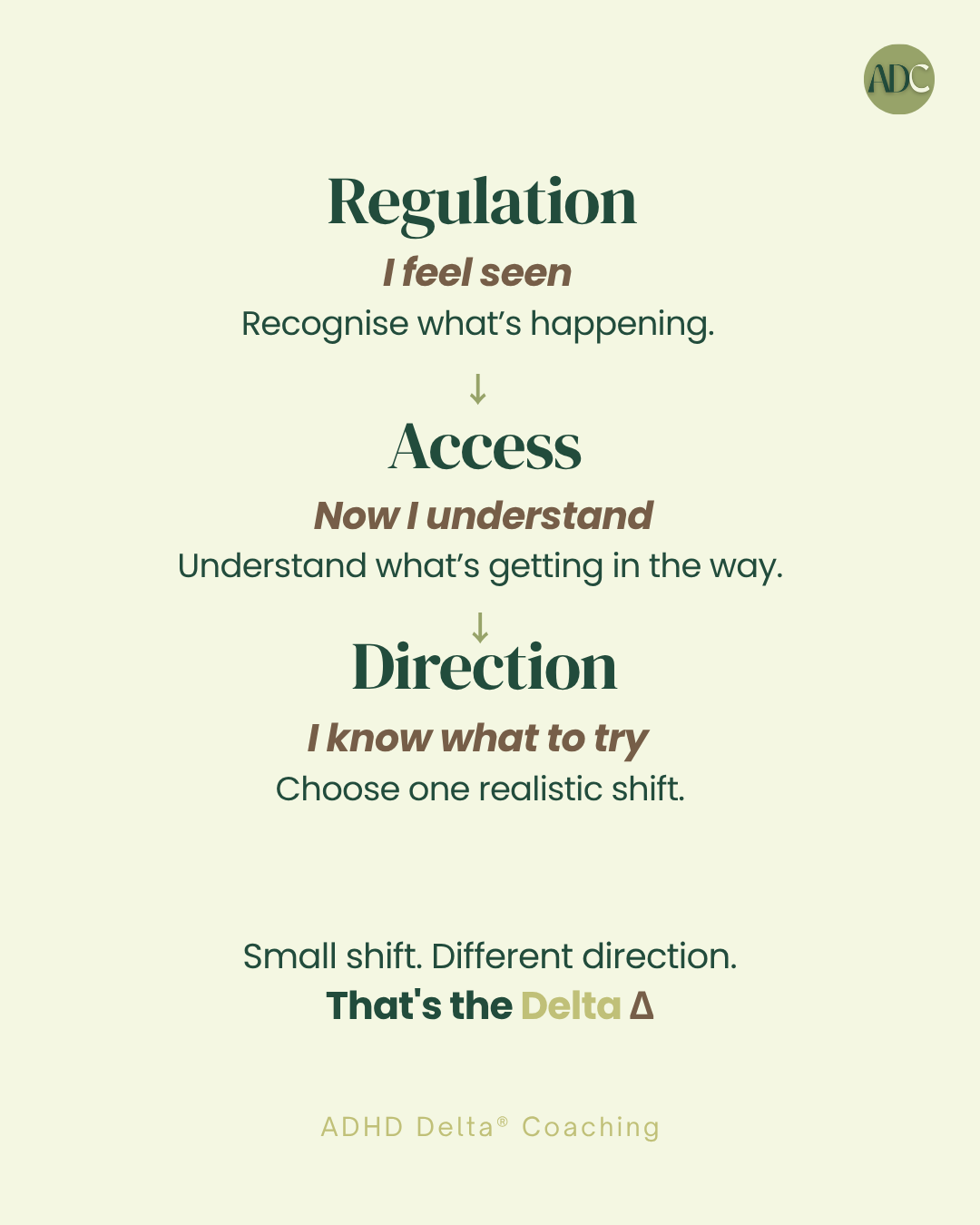
Regulation → Access → Direction
This is why my ADHD Delta® approach uses a simple sequence:
Regulation → Access → Direction
I call it RAD.
Regulation: What state am I in?
Before asking what you should do next, notice what state you're trying to do it from.
You might be calm and ready to engage.
Or you might be overwhelmed, frustrated, restless, tired or carrying the residue of whatever happened five minutes ago.
The aim isn't to achieve some perfectly regulated state before you're allowed to begin.
It's simply to recognise that your current state can affect what is accessible to you.
Access: What's getting in the way?
Now we can look at the task itself.
Perhaps it feels enormous.
Perhaps the first step is vague.
Maybe there are too many choices.
Perhaps you're trying to keep the whole process in working memory.
Or perhaps there is nothing particularly wrong with the task - you just cannot seem to get enough momentum to enter it.
Instead of treating all of these as the same problem, we can identify the particular point of friction.
Direction: What's the next useful move?
Only then do we decide what to do.
And importantly, the answer doesn't have to be the entire plan.
It might simply be the next useful move.
That's often enough to create a little movement.
The ADHD Delta Coaching Lens
Sometimes the person isn't what needs changing
Once we have a better sense of what's getting in the way, support can become much more practical.
Instead of automatically asking the person to put in more effort, we can look at what might be changed around the difficulty.
Sometimes the starting point needs to be clearer.
Sometimes there's simply too much to hold in your head at once.
Sometimes a task needs to feel smaller before you can find your way into it.
Sometimes changing the environment, reducing a decision or getting your body moving can shift what feels possible.
And sometimes you've already started, stopped and lost momentum - so the goal isn't to create another perfect plan. It's simply to find a way back in.
In my ADHD Delta® approach, I think of these kinds of adjustments as Deltas: small, intentional shifts based on what's making access difficult in that particular moment.
The aim isn't to collect more strategies or have another list of things you're supposed to remember to do.
It's to become better at noticing where the friction is and finding a response that fits.
Because the same strategy won't work for every person, every task or even every day.
Sometimes the smallest useful change is enough.
From awareness to access
ADHD awareness matters.
It can reduce shame, challenge outdated assumptions and give people language for experiences they may have spent years struggling to explain.
But awareness doesn't mean we suddenly stop having difficult moments.
Understanding ADHD doesn't automatically tell you what will help when it's 3:30 on a Wednesday afternoon, your brain has had enough, there are six things competing for your attention and you don't know where to begin.
That's where awareness becomes personal.
Instead of only asking:
“Why am I like this?”
we can begin asking:
“What's making access difficult right now?”
And then:
“What could I change here?”
The answer doesn't always need to be dramatic.
Sometimes it's one decision removed.
One step made visible.
One expectation reduced.
One clearer starting point.
One change of environment.
One way back into something you thought you'd abandoned.
Small shift. Different direction. That's the Delta Δ.
Want to explore your own access patterns?
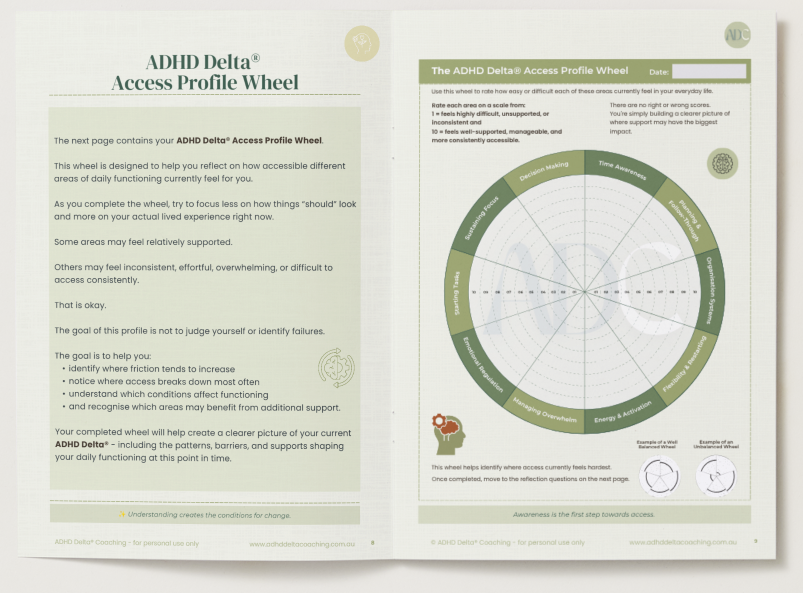
The free ADHD Delta® Access Profile is a guided reflection tool designed to help you notice where access tends to become difficult across areas such as task initiation, overwhelm, focus, time awareness, working memory load and emotional regulation.
There is nothing to score and no “right” profile to achieve.
It's simply a place to start noticing your patterns - because understanding where access becomes difficult can help you think differently about what support might help.