

Why “What’s Your Plan?” Can Feel Like Such a Big Question With ADHD

“What’s your plan?”
It’s such an innocent question.
It can even be a necessary question.
We ask it of family, friends and colleagues all the time. We need to make plans. We need to know when people are available. We need to organise weekends, holidays, catch-ups and all the other things that make life and relationships work.
And yet, sometimes “What’s your plan?” can feel like a very big question.
Especially when you have ADHD and you’re already carrying an endless list of things you haven’t quite managed to get on top of.
When you’re trying to stay focused on the next thing.
When there are messages you still need to answer, appointments you need to make, things around the house you need to sort out, work you need to finish and decisions you’ve already been postponing.
Sometimes you don’t want to think about next weekend.
You’re trying to get through today.
And then someone asks:
What are you doing this weekend?
When can we catch up?
What are your holiday plans?
And suddenly, a perfectly reasonable question feels strangely overwhelming.
Because the question isn't always as small as it sounds
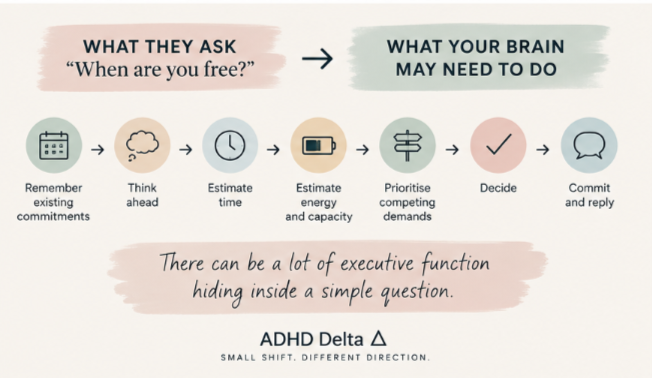
To answer “When are you free?”, you may need to do much more than look at your calendar.
You may need to think ahead.
What is already happening that week?
What needs to get done that hasn't actually made it onto the calendar?
What might you have forgotten?
When will you need downtime?
What does everyone else in the family have happening?
If you use Saturday for this, when will you do the other thing?
Do you actually want to do something that weekend, or are you desperately hoping nobody asks anything of you?
And then you have to make a decision.
Commit to it.
Put it somewhere you'll remember.
And organise everything else around it.
So a question that sounds like:
“When are you free?”
can quietly require planning, working memory, time awareness, prioritising, decision-making and the ability to imagine your future capacity.
That’s quite a lot of executive function hiding inside one innocent question.
“But you seem to make time for other things…”
This is where it can get difficult in relationships.
Imagine being the friend waiting for an answer.
You’ve asked when you can catch up and haven’t received a reply.
Meanwhile, you see that person attend someone’s birthday. Visit family. Take the kids somewhere. Go to an event.
It would be completely understandable to think:
You clearly have time to do things. Why can’t you make time for me?
And sometimes there may genuinely be a relationship issue that needs addressing.
But sometimes something else is happening.
Many of the things already happening in someone’s life arrive with their structure attached.
A birthday invitation might say:
Saturday. 2pm. This location.
A child’s activity is:
Wednesday. 5pm.
A family event may already have been organised by somebody else.
Or perhaps somebody needed something and the person simply responded in the moment.
This can be particularly relevant for people who naturally respond to other people’s needs. You can end up incredibly busy without feeling as though you deliberately planned very much of it.
Compare that with:
“We should catch up. When are you free?”
Now you have to create the structure.
You have to search through your future, find the space, decide what you’re willing to do with that space, suggest something, coordinate it and commit.
Once both events are on the calendar, they look exactly the same.
But they didn’t necessarily require the same amount of executive function to get there.
Sometimes the real issue is agency

This is another part that can be easy to miss.
You may not actually want an empty life.
You don’t necessarily want to stop seeing people.
You don’t want nobody to invite you anywhere.
And none of this means that people should stop asking questions because someone has ADHD.
Sometimes what you’re craving is simply the feeling that you have some control over your own time.
You want to know what you’re doing.
You want to feel on top of the things that matter to you.
You want to decide where your time goes rather than continually responding to whatever feels most immediate.
You want to feel like you’re holding the steering wheel of your own life - if that is even possible. 😄
And when you’re already struggling to find that sense of direction, another question about what you’re going to do with your future time can touch a surprisingly sensitive spot.
The unanswered message isn't necessarily the answer
This matters because the person on the other side of that unanswered message can't see any of this.
They just see silence.
And silence can hurt.
Understanding the executive-function load behind planning doesn’t mean relationships become one-sided or that ADHD excuses never responding to people.
But it can help explain something that otherwise looks very personal.
You can care about someone and still struggle to make the plan.
And the person waiting for you can understand why you’re struggling and still reasonably want an answer.
Both things can be true.
Sometimes we can make the question smaller
If you’re the person struggling to answer, you don’t necessarily have to solve the entire future before replying.
Sometimes:
“I genuinely don’t know yet. Can I come back to you on Friday?”
is an answer.
And if you’re trying to make plans with someone who finds open-ended planning difficult, sometimes reducing the number of decisions can help.
Instead of:
“When are you free?”
you might try:
“I’d love to catch up. I’m free Saturday morning or Wednesday evening. Would either work for you?”
There’s less future to search. Fewer options to generate. A smaller decision to make.
Not everyone needs this, of course.
But sometimes changing the question changes how much access the person needs to answer it.
So, this isn't about not asking “What's your plan?”
Please ask.
We need these questions.
It’s simply worth recognising that sometimes, when someone with ADHD hesitates, avoids the question or takes far too long to answer it, what looks like a simple social decision from the outside may not feel simple from the inside.
Sometimes the delay isn’t about how much they value you.
Sometimes they haven’t managed to get far enough ahead of today to answer a question about tomorrow.
And sometimes the most useful question isn’t:
“Why can’t I just make the plan?”
It might be:
“What is making this decision so hard to access right now?”
Because once you can see the hidden load, you have something you can actually work with.
Small shift.
Different direction.
That’s the Delta Δ