


Why “What’s Your Plan?” Can Feel Like Such a Big Question With ADHD
Sometimes “What’s your plan?” asks more of the brain than it seems. Explore the hidden executive-function load behind making plans with ADHD.

When Working Harder Stops Working: Understanding ADHD Overwhelm and Executive Dysfunction
There comes a point in life when the very strategies that helped us succeed begin to work against us.
For many adults with ADHD, those strategies were never about efficiency.
They were about compensation.

Why ADHD Impulsivity Often Isn’t About Self-Control
Many adults with ADHD are told they're impulsive because they lack self-control. But what if the real issue is that emotional urgency temporarily disrupts your ability to pause, think clearly, and respond intentionally? This article explores reflective access, self-trust, and why support changes access.

ADHD Task Initiation Problems: Why You Know What To Do But Still Can’t Start
You know what needs to be done. You’ve thought about it repeatedly. You probably even want to do it.
But when it’s time to begin…nothing happens.
ADHD task initiation problems are often misunderstood as laziness or lack of motivation. But many starting struggles are actually about cognitive overload, reduced access, and invisible friction inside the brain.
This blog explores why ADHD brains can suddenly “freeze,” why simple tasks can feel impossible to enter, and why support often works better than pressure.

Why ADHD Brains Struggle With Change (And How Predictability Restores Stability)
Things can be working…and then suddenly they’re not.
Nothing obvious happened, but everything feels harder - starting, focusing, following through.
It’s easy to think something’s wrong with you. But often, something changed
And your brain lost something it was relying on.

Why Focus Is So Hard with ADHD (And Why It’s Not About Willpower)
Many people searching for answers about ADHD focus problems are told that they simply need better discipline or time management. But difficulty focusing with ADHD is not usually a motivation issue. It is an executive function access issue - shaped by emotional regulation, nervous system safety, and the structure around us.
Understanding this changes the way we approach focus entirely.

ADHD Emotional Regulation: Why Emotions Feel Bigger & What helps
If you’ve ever watched a conflict with a partner, teen, colleague or friend escalate faster than a runaway train - only to wonder “Why did this blow up over that?” - you’re not alone. People with ADHD don’t just experience emotions; they feel them intensely, quickly, and often without warning. And that brain-based emotional response can show up as frustration, withdrawal, impulsivity, or overwhelm in our closest relationships.
This blog explores what emotional regulation actually means and provides some tools that work in real life — not just in theory.

Why ADHD Resolutions Fail by Week Two (and What Actually Helps Instead)
If you're reading this sometime after January 15th and you're already feeling that familiar, sinking guilt about the three ambitious New Year's resolutions currently gathering dust, welcome to the club. If you have ADHD, that club is roughly the size of a small, highly distractible nation.
For us, the new year often brings a potent cocktail of optimistic motivation (hello, dopamine!) mixed with a deep-seated belief that this time we’ve cracked the code. We set gigantic, shiny goals only to realise by the second week that our executive functions didn't magically update along with the calendar year…

Let’s Close This Year With Kindness (And a Brain-Friendly Reset)
The end of the year can feel heavy when you have ADHD.
There’s often pressure to reflect, plan, wrap things up - and somehow feel motivated about what’s next - all at the exact moment your energy is lowest and your routines are the most disrupted.
If you’re feeling flat, overwhelmed or quietly disappointed with yourself, let me say this clearly:
This is not a personal failure. It’s a nervous system and executive function reality.
This blog is an invitation to close the year with kindness, not criticism — and to reset in a way that actually works for ADHD brains.
Beyond the Symptoms - What is ADHD?
October is ADHD Awareness month, and it’s aimed at raising awareness, promoting accurate information sharing and reducing stigma. What better time is there to write about ADHD than now?! When most people hear “ADHD,” they think of the classic stereotypes: the restless child who can’t sit still, the student who drifts off in class, or the adult who constantly forgets their keys. While these snapshots capture fragments of the experience, they don’t tell the whole story. ADHD is far more complex, and understanding it requires going beyond the symptoms.
So, "What exactly is ADHD beyond what we see on the surface?"
The "Just 5 Minutes" Rule: Your Secret Weapon Against Procrastination
Have you ever felt like you're stuck in quicksand when faced with a big task? You want to start, you know you should start, but the sheer size of it feels paralyzing. 😩 For many people with ADHD, this feeling is all too familiar.
The "Just 5 Minutes" rule is an ADHD procrastination hack for breaking the inertia by removing the emotional barrier to starting, proving to your brain that you can start, and building consistent momentum, one micro-commitment at a time.

5 Micro-Steps to Conquer the Blank Page
Ever stared at a blank document, an empty inbox, or a new project and felt absolutely paralyzed? You're not alone! For many professionals with ADHD, the "blank page blues" are a real and frustrating hurdle to getting started. It's not about laziness; it's about how our amazing ADHD brains sometimes get stuck. Perfectionism can whisper "it has to be perfect, or don't bother." Overwhelm can scream "there's too much to do, where do I even begin?!" And executive dysfunction can just make that first step feel like climbing Mount Everest in flip-flops.
Hyperfocus - the Hero and the Villain of ADHD
Ever get super into something with ADHD and totally lose track of time? That's hyperfocus. It can be awesome for getting stuff done, like really diving deep into work or hobbies. You can become a productivity machine and learn new skills super-fast!
But that intense focus can also be a pain and lead to burnout.

Distractions and ADHD - A Guide to Staying Focused
Distractions are an unavoidable reality in the hustle and bustle of everyday life. For individuals with Attention-Deficit/Hyperactivity Disorder (ADHD) however, these distractions can be particularly disruptive. ADHD affects the brain's executive functions, which include attention, focus, and impulse control. This can lead to increased susceptibility to distractions, both external and internal…
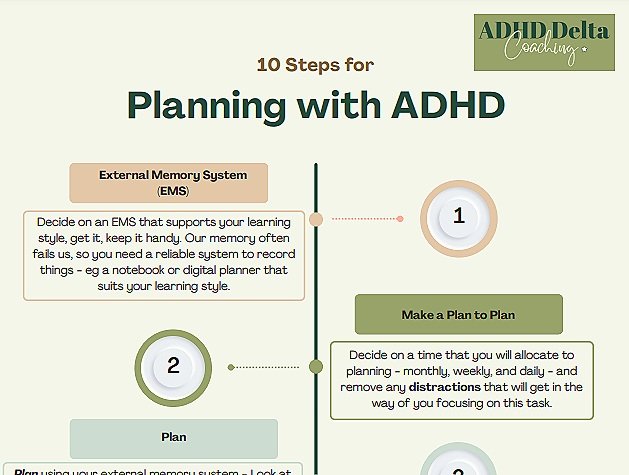
How to Create Plans That Work for People With ADHD
Planning is a core executive functioning skill that is often not at its optimal level of performance for people with ADHD (Attention Deficit and Hyperactivity Disorder).