

When Working Harder Stops Working: Understanding ADHD Overwhelm and Executive Dysfunction

There comes a point in life when the very strategies that helped us succeed begin to work against us.
For many adults with ADHD, those strategies were never about efficiency.
They were about compensation.
Have you ever felt like the systems that used to keep your life on track just... stopped working?
It's a common experience for many adults with ADHD. The planner you once loved now sits untouched. The last-minute pressure that used to get you moving doesn't seem to work in quite the same way. Even the routines you worked hard to build seem to have disappeared.
And that's confusing, because you know you're still the same capable person you've always been.
Things that once felt manageable can suddenly feel much harder to start. And when that happens, it's easy to assume that something has gone wrong with you.
But sometimes the simpler explanation is that life has changed - and the strategies that helped you manage an earlier version of it can no longer carry quite so much.
When the strategy hasn't changed, but life has
When things start feeling messy, our first instinct is often to look for a better strategy.
Maybe I need a better planner.
Maybe I need another app.
Maybe I just need to be more disciplined about using the system I already have.
But sometimes the strategy isn't the problem. The demands around it have changed.
Your role at work may have become more complex. Perhaps you've started a business, taken on caring responsibilities, returned to study or you're simply juggling more decisions, expectations and responsibilities than you were before.
A strategy that worked when you had five things to hold may naturally struggle when you're holding fifteen.
That doesn't make it a bad strategy.
It may simply have been designed for a version of your life that no longer exists.
ADHD overwhelm isn't always obvious
ADHD overwhelm doesn't always look like everything falling apart.
You might still be working. Still meeting deadlines. Still taking care of other people. Still appearing completely capable from the outside.
But internally, ordinary things can start requiring an exhausting amount of effort.
Starting takes longer. Decisions feel heavier. You think about tasks repeatedly without actually moving into them. You lose track of things you normally remember. You find yourself increasingly reliant on urgency just to get moving.
Even a small interruption can make it harder to return to what you were doing.
Before long, you can be working harder while feeling like you're accomplishing less.
It's easy to make that personal.
Why can't I just get on with it?
I've done this before.
I know what I need to do.
But knowing what to do and being able to access it in that moment are not always the same thing.
Executive dysfunction isn't a lack of knowledge
One of the most frustrating parts of executive functioning difficulties is that the knowledge can still be there.
You understand the deadline. You have the skills. You genuinely want the task finished.
And yet, you still struggle to begin.
That gap can easily be interpreted as laziness, procrastination or a lack of motivation.
But there's another question we can ask:
What is making this task difficult to access right now?
Perhaps the entry point isn't clear.
Maybe there are too many decisions involved in getting started.
You might be trying to hold all the steps in your head, or the task may feel much larger internally than it appears from the outside.
Sometimes your available capacity is simply being used elsewhere.
The difficulty isn't necessarily in knowing what to do.
Sometimes it's in finding a way in.
When working harder creates more friction
For many capable adults with ADHD, working harder has historically worked.
Pressure can activate us. Deadlines create urgency. Fear of disappointing someone can generate momentum. Long hours can compensate for not getting started earlier.
And for a while, those strategies can work remarkably well.
The problem comes when we begin treating effort as though it's unlimited.
When things get harder, we add more.
More pressure.
More hours.
More reminders.
More expectations.
More conversations with ourselves about what we should be able to do.
But if the system is already overloaded, adding more pressure can increase the very friction we're trying to overcome.
So, the task may not have changed.
But the cost of accessing it has.
And that's an important distinction.
Sometimes the first intervention is less
If the problem is already too much load, adding more effort rarely creates more capacity.
Sometimes the first useful question is simply:
What can I make lighter?
What doesn't need to happen today?
What are you holding mentally that could be written down?
Which decision could be made once instead of repeatedly?
What expectation no longer fits your current capacity?
Could the task have a smaller entry point?
This isn't about abandoning responsibility or lowering every expectation.
It's about creating enough room for the things that matter to become more accessible.
Sometimes movement doesn't come from adding something new.
It comes from making the load a little lighter.
Regulation before access
Executive functioning isn't simply a collection of productivity skills. Our ability to access those skills can change depending on our physical, emotional and cognitive state.
When we're tired, overstimulated or overloaded, something that felt straightforward yesterday can feel incredibly difficult today.
This is where regulation matters.
Not as another thing to do perfectly, but as a way of noticing what you might need before asking more of yourself.
Sometimes regulation looks like stepping away for an hour. It might be movement, food, sleep or reducing sensory input.
And sometimes it's much smaller.
A pause between tasks.
A few minutes outside.
Changing rooms.
Slowing down long enough to notice what is actually making the next step difficult.
The aim isn't to reach a perfectly calm state before doing anything.
It's to create enough capacity for access to become possible again.
Regulation → Access → Direction.
When we support the state we're starting from, we make it easier to access what we know.
And once we have access, choosing a direction becomes easier.
Your old strategies weren't necessarily wrong
There's something else worth saying here.
If a strategy helped you get through university, build a career, raise a family, run a household, start a business or simply navigate years of life without understanding why certain things felt harder for you, then it served a purpose.
You don't have to dismiss it because it no longer works.
But you also don't have to remain loyal to it.
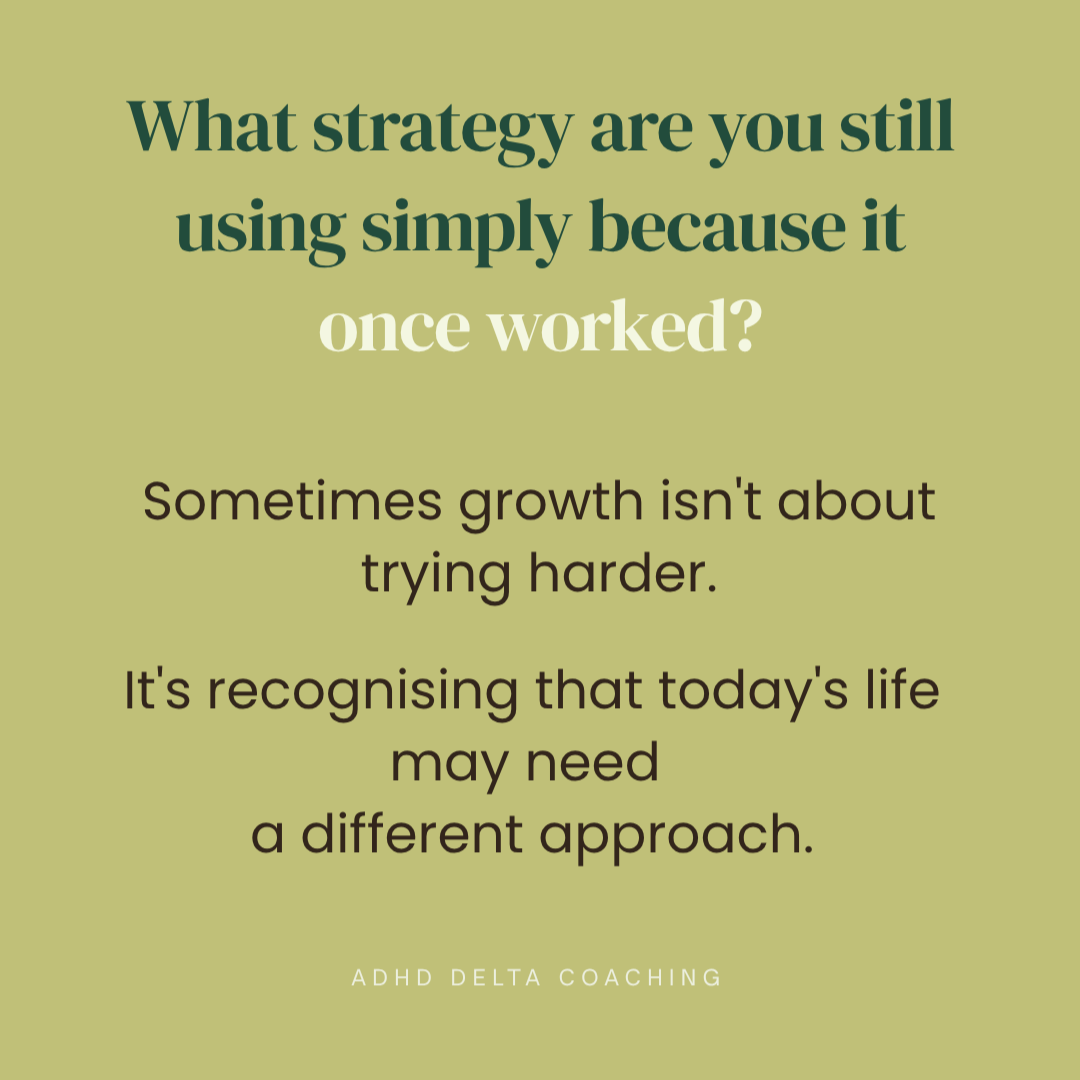
Sometimes growth looks less like finding the perfect strategy and more like noticing when an old one has reached its limit.
Your circumstances have changed.
Your responsibilities may have changed.
Your capacity can change from day to day.
Your systems are allowed to change too.
Δ Delta Moment
You don't have to redesign your whole life today.
Notice one place where you're applying more effort to something that has become harder to access.
Then ask:
What would make this easier to enter?
Maybe something needs to become smaller.
Maybe something needs to become visible.
Maybe a decision needs to be removed.
Maybe something can be let go.
Sometimes the shift isn't doing more.
It's reducing enough friction to make movement possible again.
Small shift.
Different direction.
That's the Delta Δ.