

Why Focus Is So Hard with ADHD (And Why It’s Not About Willpower)
There is a moment many adults and teens with ADHD experience - often quietly - when they begin to question themselves. They wonder why focus feels so inconsistent. Some days they can engage, think clearly, begin tasks, and follow through. Other days, even starting feels out of reach.
The same person. The same task. A completely different internal experience.
It’s confusing. And over time, it can erode trust in yourself.
Many people assume this inconsistency is a problem with motivation, discipline, or effort.
But focus is not a character trait.
It is a state - and that state is shaped by emotional regulation, nervous system safety, and the structure around us. Understanding this changes everything.
When you begin to understand how focus actually works in the ADHD brain, the experience of inconsistency starts to make sense.

Why Focus Can’t Be Forced
Many people searching for answers about ADHD focus problems are told that they simply need better discipline or time management. But difficulty focusing with ADHD is not usually a motivation issue. It is an executive function access issue. Executive functions help the brain initiate tasks, sustain attention, and organise information. When emotional overwhelm, uncertainty, or cognitive load increase, these functions become harder to access. This is why someone with ADHD can care deeply about a task and still struggle to begin or maintain focus. The challenge is not effort - it is access.
Focus is often treated as something that should be available on demand. Something you access simply by trying harder. But the brain does not release focus in response to pressure. It releases focus when conditions feel manageable and safe enough to engage.
When emotional overwhelm is high, the brain shifts into protection mode.
Its priority becomes stabilising uncertainty and emotional intensity - not planning, organising, or beginning tasks. This is why focus can feel inaccessible during periods of stress, overwhelm, or emotional dysregulation. It’s not that focus has disappeared. It’s that the brain cannot safely access it yet.
Why ADHD Makes Focusing Hard
ADHD makes focusing hard not because people with ADHD lack effort or interest, but because the brain regulates attention differently. When executive functions are overloaded or emotional intensity rises, access to sustained attention becomes more difficult. Supporting the brain’s environment and reducing overwhelm helps restore that access.
Focus Becomes Accessible When Emotional Overwhelm Decreases
In February, we explored how emotional regulation shapes the way the brain processes intensity and overwhelm. The same principle applies to focus.
When emotional intensity is high, attention narrows. The brain becomes more sensitive to perceived difficulty, uncertainty, and cognitive load. Even tasks you want to complete can feel heavier than usual.
As emotional intensity lowers, access to executive function becomes easier again - and attention becomes easier to direct.
This is why emotional regulation is not separate from productivity. It is foundational to it. Focus becomes possible when emotional overwhelm decreases and executive function access returns.
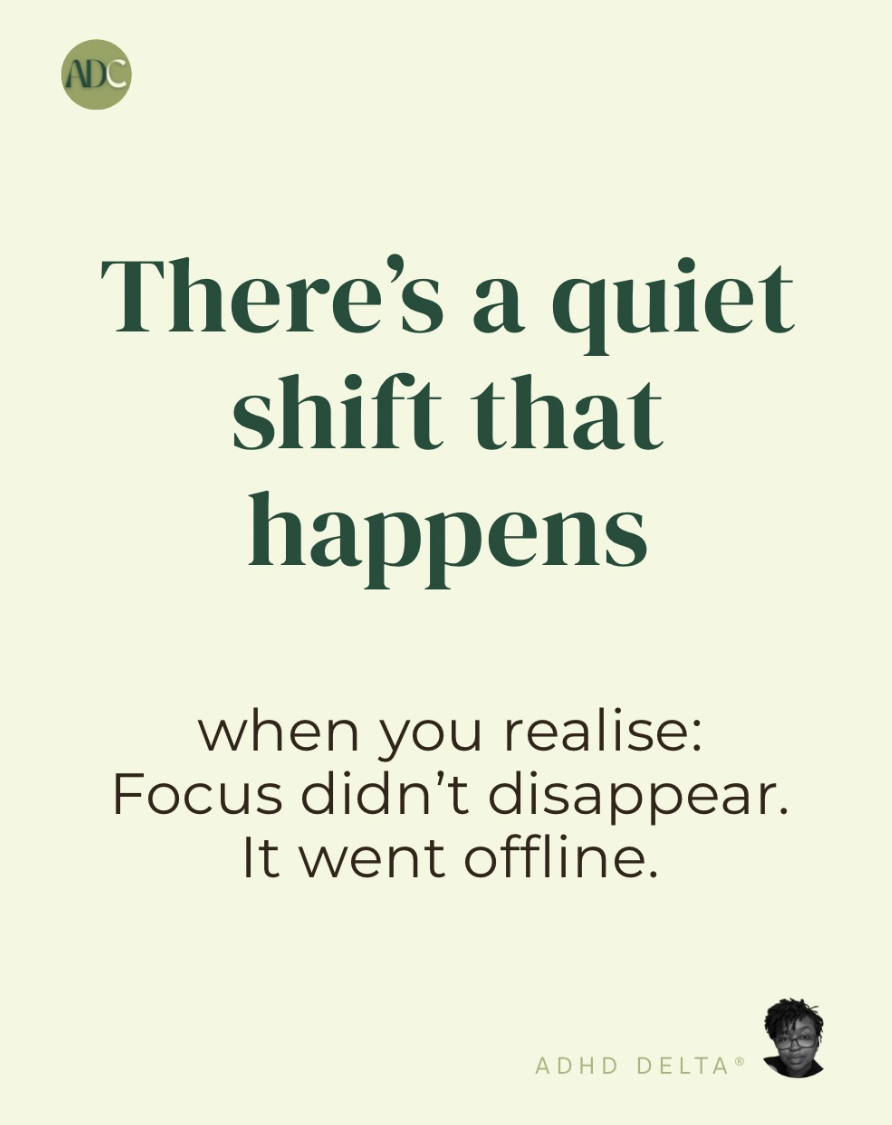
I recently shared this reflection about focus and nervous system safety.
Key Insight
Focus is not something ADHD brains can reliably access through pressure.
Focus becomes accessible when emotional overwhelm decreases and the brain feels safe enough to engage.
Attention Responds to Conditions, Not Self-Criticism
ADHD attention is highly responsive to context. One of the most powerful shifts clients experience is moving from self-criticism to curiosity.
Instead of asking,
“Why can’t I focus?”
they begin asking,
“What does my brain need right now to engage?”
Attention naturally moves toward what feels clearer, safer, and more manageable. In ADHD brains, attention is often regulated by activation and interest rather than importance alone. It moves away from what feels overwhelming, uncertain, or cognitively heavy.
This is not avoidance. It is a protective function of the nervous system. When you reduce uncertainty and emotional intensity, attention becomes easier to direct.
Focus Improves When It’s Supported by Structure
Many people try to improve focus by increasing effort. But focus responds more reliably to structure than to force. When the starting point is clear, when tasks are broken into manageable steps, and when emotional overwhelm is supported, focus becomes more accessible.
This is why external structure is so important for ADHD brains. Structure reduces uncertainty and cognitive load.
Reduced cognitive load lowers emotional resistance, and lower resistance makes engagement possible.
Focus becomes accessible when these conditions are present.
How Focus Becomes More Predictable Over Time
Perhaps the most important shift is not that focus becomes perfect. It’s that it becomes more predictable.
Over time, as emotional regulation and external structure work together, the brain begins to trust that it is safe enough to engage. And you begin to trust yourself again. Not because you forced change. But because you created conditions that supported it.
This is how sustainable focus develops.
Not through discipline alone, but through understanding how your brain works.
Practical Tools to Support Emotional Regulation and Focus
If focus has felt inconsistent or inaccessible, the starting point is not forcing yourself harder. It’s supporting emotional regulation and creating structure that reduces overwhelm.
The Focus Support Toolkit below, provides you with practical ways to support focus and reduce overwhelm.
The toolkit includes reflection prompts, structure-building tools, and a focus reset protocol designed to make attention more accessible.
If you’d like help building structure that supports your brain, you can explore ADHD coaching support here.
Focus didn’t disappear.
It became inaccessible.
When overwhelm lowers and structure increases, access returns.
Small shift. Different direction.
So remember…
Focus was never about trying harder.
It was about creating conditions your brain could trust.
Sometimes the change is smaller than we expect.
A small shift in how we support the brain can change the direction entirely.
And when those conditions shift, focus becomes accessible again.