Why ADHD Brains Struggle With Change (And How Predictability Restores Stability)
If you have ADHD, you may notice that things can be working… and then suddenly they’re not.
Nothing obvious happened, however everything feels harder -
→ Starting
→ Focusing
→ Following through
It’s easy to go straight to:
“What’s wrong with me?”
“I need to be more consistent”

But often, it’s not that.
Something changed.
Why change is hard for ADHD brains
Change doesn’t just affect your routine. It affects your access.
ADHD brains don’t rely on motivation as much as we think.
They rely on predictability.
Predictability reduces the number of decisions your brain has to make.
It creates structure
It lowers cognitive load
It supports access to starting and focus
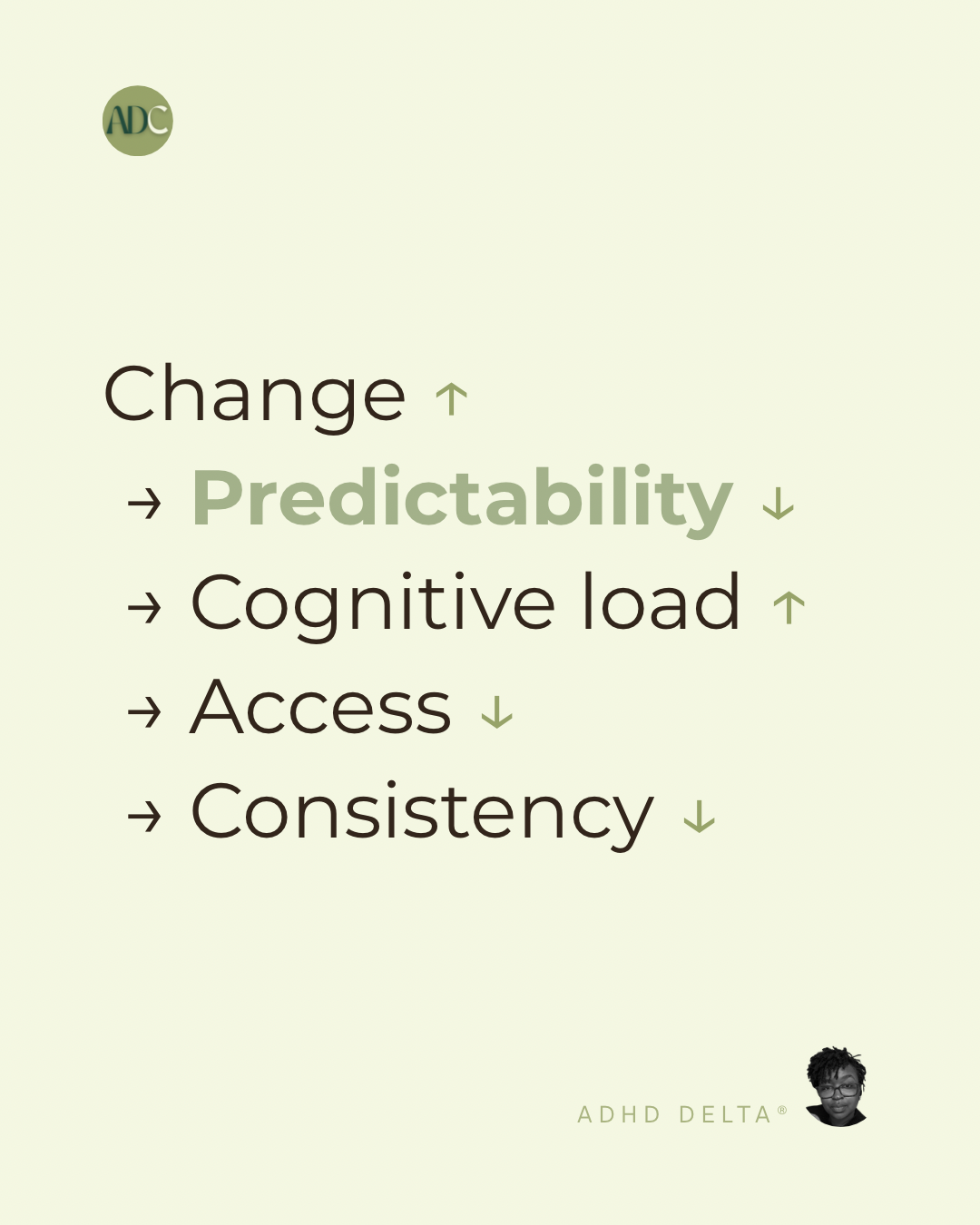
When that predictability is disrupted - even slightly - your brain has to work harder.
This is often described as difficulty with ADHD transitions - shifting from one state, task, or routine to another.
What change actually does to your brain
When something shifts -
your routine
your environment
your timing
Your brain loses reference points.
Things that used to be automatic, now require effort.
Things that felt simple, now feel heavier.

Not because you’ve lost motivation
But because your brain is trying to re-stabilise
This is why transitions can feel disproportionately hard.
Why it can feel like everything falls apart
After a change, your brain is doing two things at once:
👉 Trying to re-orient
👉 Trying to function
That increases load. And when load increases, access decreases.
So it becomes harder to:
start tasks
stay consistent
follow through
return to things you were doing
Not because you’re inconsistent, but because the system you were relying on no longer fits
This shows up in everyday moments
You change your schedule
and suddenly your morning routine doesn’t work
You move environments
and your focus drops
You take a break from something
and can’t get back into it
You go through a life transition
and everything feels harder than it should
This isn’t failure
This is a loss of predictability
For students, families, and life transitions
This is especially noticeable during bigger transitions:
moving from high school to uni
starting a new job
returning to work after a break
adjusting to family changes
managing shifting routines with children
What looks like “struggling to cope”, is often the brain trying to adjust to a completely new set of expectations.
And without predictable structure, everything requires more effort.
The shift: stability before productivity
When things feel off, the instinct is often to push harder
To try to get back on track
To rebuild everything at once
But that usually increases pressure
Instead
Start with stability
Not everything
Just one thing
How to rebuild predictability
Look for something small you can stabilise.

A consistent start point
A repeatable first step
A familiar environment
A simple structure you can return to
You’re not trying to fix everything.
You’re giving your brain something it can rely on again.
That’s what reduces load.
And when load reduces, access begins to return.
Predictability stabilises attention and emotion
This is the part most people miss
When your brain feels more stable,
it’s easier to:
start
focus
regulate
follow through
Not because you’ve become more disciplined
But because your system has support again
You didn’t fall off
Something shifted
And when you understand that
You stop pushing
And start adjusting
That’s where things begin to feel doable again
If this keeps happening
If ADHD transitions often feel harder than they should
If you find yourself losing momentum when routines shift
This is exactly what we work through together
We’ll look at what’s changed
what your brain was relying on
and how to rebuild stability
in a way that actually works for you
Small shift.
Different direction.
That’s the Delta Δ